
Finance Minister Nirmala Sitharaman on Saturday announced six new schemes and increased the subsidised Kisan Credit Card (KCC) loan limit to Rs 7 lakh from Rs 5 lakh, targeting everything from unemployment to crop productivity enhancement across the country. Presenting her eighth budget speech in Parliament, Sitharaman positioned agriculture as "the first engine of growth" and unveiled the Prime Minister Dhan-Dhaanya Krishi Yojana, a flagship program targeting 100 agri-districts grappling with low productivity, moderate crop intensity, and below-average credit parameters.

The Indian industry is paranoid about the USA's plan to impose reciprocal tariffs and wants early conclusion of a bilateral trade agreement, sources said on Wednesday. They said that the talks for the proposed bilateral trade agreement are going well.

The varieties will take at least 4 to 5 years to reach farmers after they complete the usual cycle of breeder, foundation and certified seeds.

Faced with a huge rise in cotton prices, the South India Small Spinners Association has urged the Centre to ban export of raw cotton.
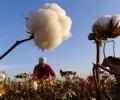
Chinese government was expected to start sales from its cotton reserves on March 6.
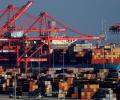
Senior officials of India and the US will begin three-day talks on the proposed bilateral trade agreement in New Delhi on Wednesday amid threats of reciprocal tariffs from the Trump-administration, an official said. To formally start the negotiations on the pact, Assistant US Trade Representative for South and Central Asia Brendan Lynch, along with a team of officials, is in New Delhi.
Recent documents by NITI Aayog and periodic labour force surveys on employment show that the importance of agriculture is rising in the Indian economy.

Whether it's navigating the labyrinthine Cu Chi Tunnels, boating on the Mekong, marveling at ancient Champa temples, or the Mekong Bay, Vietnam promises a journey like no other.
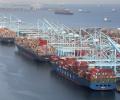
India and the US have decided to hold sector-specific talks in the coming weeks to finalise the structure of the proposed bilateral trade agreement (BTA), the government said on Saturday. The engagement between the two countries came in the backdrop of the USA's threat to impose reciprocal tariffs on its key trading partners, including India, on April 2.

Here is a list of Q & As to explain these issues and implications of the US move.

A group of onion traders gathered at the Pimpalgaon Agricultural Produce Market Committee (APMC), near Nashik, to inspect one of the season's final harvests of red onions as they look to place their bids. They were surrounded by farmers, who brought their produce here from different parts of the district. Farmers have reasons to be optimistic.
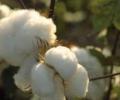
The US cotton export this year depends on how much cotton India will have on hand to export and how much import quota is issued by China, a top American cotton business executive has said. In 2008, US exports were helped by the fact that India had removed its cotton from the marketplace, he said, according to South East Farm Press.
Monsanto has envisaged the transfer of a gene from a blue flower to the cotton plant to produce blue cotton. Monsanto's current Blue Cotton programme is aimed at the jeans market ($10 bn in the US and 800 mn in the UK) and involves the transfer of a gene from a blue flower to the cotton plant. Coloured cotton is also being produced not only by conventional genetic selection but also by direct DNA engineering. Naturally coloured cotton is a new way to preserve the eco system.

India and the United States will finalize the contours, schedule of negotiations, and terms of reference for a proposed bilateral trade agreement (BTA) during a three-day meeting beginning Tuesday. The agreement is expected to be finalized in two tranches, with the first phase focusing on goods trade. The US team, led by Assistant US Trade Representative for South and Central Asia Brendan Lynch, will be in India from March 25-29 to discuss the agreement. Both countries are aiming to conclude the first phase of the agreement by fall 2025.
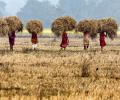
In a significant policy shift aimed at boosting agri-productivity and rural prosperity, Finance Minister Nirmala Sitharaman on Saturday announced six new agricultural schemes while increasing the subsidised Kisan Credit Card loan limit to Rs 5 lakh from the existing Rs 3 lakh, benefiting 7.7 crore farmers, fishermen, and dairy farmers.
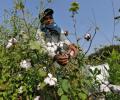
Soybean is trading at a 25 per cent premium to the MSP, after initially slipping below the government's threshold procurement price of Rs 2,850 a quintal.

A delayed monsoon and abundant cotton in the international market could spell trouble in the state's suicide zone.
Although domestic cotton production in 2007-08 is expected to be good, global productions are predicted to fall.

India's merchandise exports dipped by about one per cent to $38.01 billion in December 2024 against $38.39 billion a year ago, according to government data released on Wednesday. Imports increased by 4.8 per cent to $59.95 billion in December 2024 compared to $57.15 billion in the year-ago month.
India's fight against the growing market share of manmade fibers is beginning to get global support, especially from the Cotton Council International (CCI).
Pakistani cotton scene is turning out to be interesting with domestic producers offering the commodity at rates lower than the international prices.
According to market analysts, Pakistani cotton is available to the international and domestic buyers with a difference of 10 cents per pound to the global price.

The whitefly outbreak has intensified a debate over GM crops just as Prime Minister Narendra Modi's office reviews a proposal to allow farmers to grow GM mustard.
Global cotton prices may be hit by a record production in China this year.

'The jury panel said that my collection should not be limited to a college fashion show; it had much more potential. They encouraged me to sign up for the annual National Designer Awards organised by the World Designing Forum.'
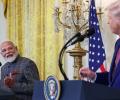
Of Trump's reciprocal tariffs and trade deals
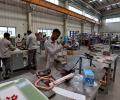
India's manufacturing sector growth fell to a joint 11-month low of 56.5 in November, restricted by competitive conditions and inflationary pressures amid a softer increase in factory orders, a monthly survey said on Monday. The seasonally adjusted HSBC India Manufacturing Purchasing Managers' Index (PMI) fell from 57.5 in October to 56.5 in November, signalling a softer improvement in the health of the sector. However, the pace of growth remained above its long-run average.
Increased use of genetically modified (GM) seeds is all set to boost the cotton output in India by almost 7 per cent in the year starting October.
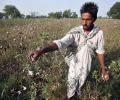
Monsanto has taken the government to court over the royalty.
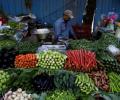
Retail inflation in August inched up to 3.65 per cent, though vegetables and pulses witnessed price rise in double digits, according to official data released on Thursday. The retail inflation based on the Consumer Price Index (CPI), however, remained below the Reserve Bank's median target of 4 per cent for the second month in a row. It was at a five-year low of 3.6 per cent in July.

The escalation of conflict in the West Asian region is expected to push already high logistics costs besides hurting trade in sectors such as oil, electronics and agriculture, according to exporters. They said that insurance costs for exports to the countries directly involved in the war could also go up, which will impact Indian exporters' working capital. Think tank Global Trade Research Initiative (GTRI) stated that the conflict is already hurting India's trade with countries like Israel, Jordan, and Lebanon.

Gold is the first product for options trading that markets regulator Sebi has allowed after 14 years of commodity exchanges in the country.

Is India headed there again? questions Ajit Balakrishnan

Response to Bt cotton has been favourable and about seven more companies are preparing to release their genetically modified cotton hybrids for commercial use shortly, a study conducted by Rabobank International says.

Govt uneasy at prices, availability for domestic consumption.
Snapping the two months slide, the country's merchandise exports rose marginally by 0.5 per cent to $34.58 billion in September while trade deficit narrowed to $20.78 billion. According to official data released on Wednesday, imports increased by 1.6 per cent to $55.36 billion in September compared to $54.49 billion in the year-ago period. The trade deficit, or the gap between imports and exports, was $20.8 billion during the same month last year.

Uzbekistan lives comfortably in several centuries but is also a forward-looking nation, Deepa Gahlot discovers on a visit to this Central Asian country.
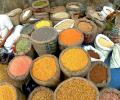
The Centre recently released the first advance estimates of kharif crops that, barring tur dal, showed a dip in production due to uneven monsoon and other natural calamities including pest attacks in cotton. The first Advance Estimates, released a few weeks back, are usually initial projections on the crop size and, more often than not, are revised as more inputs come from the fields. But, the findings have rung alarm bells in several quarters. The Centre, along with many others, is confident that as more details come, the estimates will be revised upwards.
